Wire wrapping is one of the oldest techniques for making handmade jewelry. This technique is done with jewelry wire and findings similar to wire (for example, head-pins) to make components. Wire components are then connected to one another using mechanical techniques with no soldering or heating of
A bijou (plural: bijoux) from the French bijou (pl. bijoux) is an intricate jewellery piece incorporated into clothing, or worn by itself on the body. Use Besides its decorative function, a bijou serves as a signal for many other purposes. These have varied over time and space, and really its percei
Orthoclase, or orthoclase feldspar (endmember formula KAlSi3O8), is an important tectosilicate mineral which forms igneous rock. The name is from the Ancient Greek for "straight fracture", because its two cleavage planes are at right angles to each other. It is a type of alkali feldspar, also known
Shell gorgets are a Native American art form of polished, carved shell pendants worn around the neck. The gorgets are frequently engraved, and are sometimes highlighted with pigments, or fenestrated (pierced with openings). Shell gorgets were most common in Eastern Woodlands of the United States, du
The Design Museum Den Bosch (previously: Stedelijk Museum 's-Hertogenbosch, SM's) is a museum in 's-Hertogenbosch, The Netherlands. It focuses on the applied arts, in particular ceramics and jewellery. It is next door to the Noordbrabants Museum, which shows visual arts such as painting. In 2023, pl
Chlorastrolite, also known as Isle Royale Greenstone, Green Starstone, and Turtle Back, is a green or bluish green stone. Chlorastrolite has finely radiating or stellate (for examples, see crystal habits) masses that have a "turtleback" pattern. The stellate masses tend to be chatoyant, meaning they
Goshenite is a colorless gem variety of beryl. It is sometimes called the “mother of all gemstones” because the addition of various trace elements in nature transforms it into other gems, such as emerald, aquamarine, morganite, or bixbite. Goshenite is also the purest form of beryl because the inclu
Peridot (/ˈpɛrɪˌdɒt/ PERR-ih-dot), sometimes called chrysolite, is a yellow-green transparent variety of olivine, specifically the magnesium rich end member called forsterite. Peridot is one of the few gemstones that occur in only one color. Peridot can be found in mafic and ultramafic rocks occurri
Verd antique (obsolete French, from Italian, verde antico, "ancient green"), also called verde antique, marmor thessalicum, or Ophite, is a serpentinite breccia popular since ancient times as a decorative facing stone. It is a dark, dull green, white-mottled (or white-veined) serpentine, mixed with
Muscovite (also known as common mica, isinglass, or potash mica) is a hydrated phyllosilicate mineral of aluminium and potassium with formula KAl2(AlSi3O10)(OH)2. It has a highly perfect basal cleavage yielding remarkably thin laminae (sheets) which are often highly elastic. Sheets of muscovite 5 by
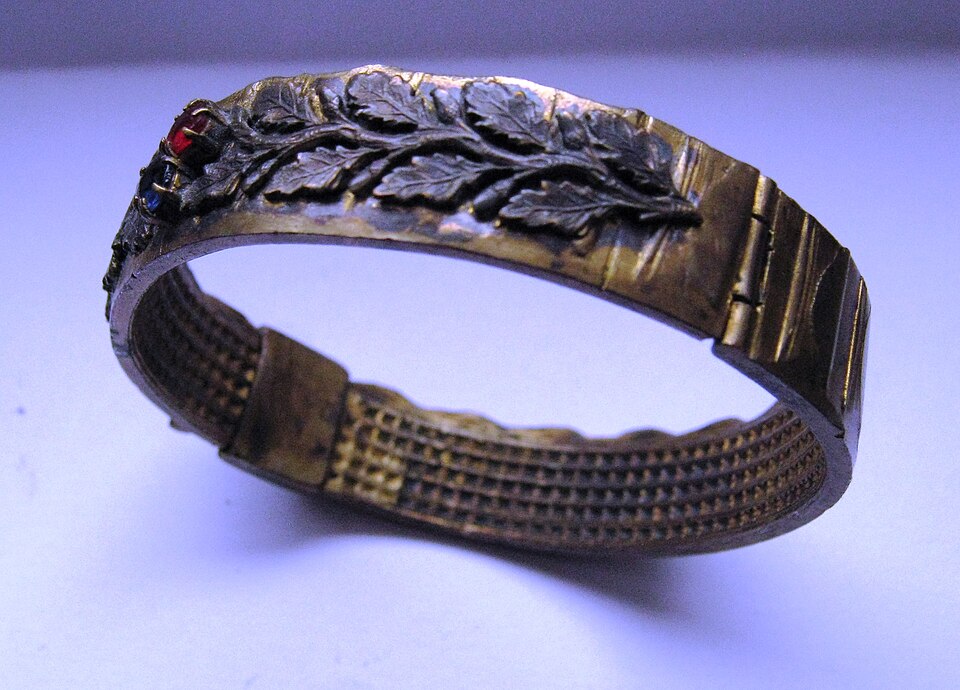
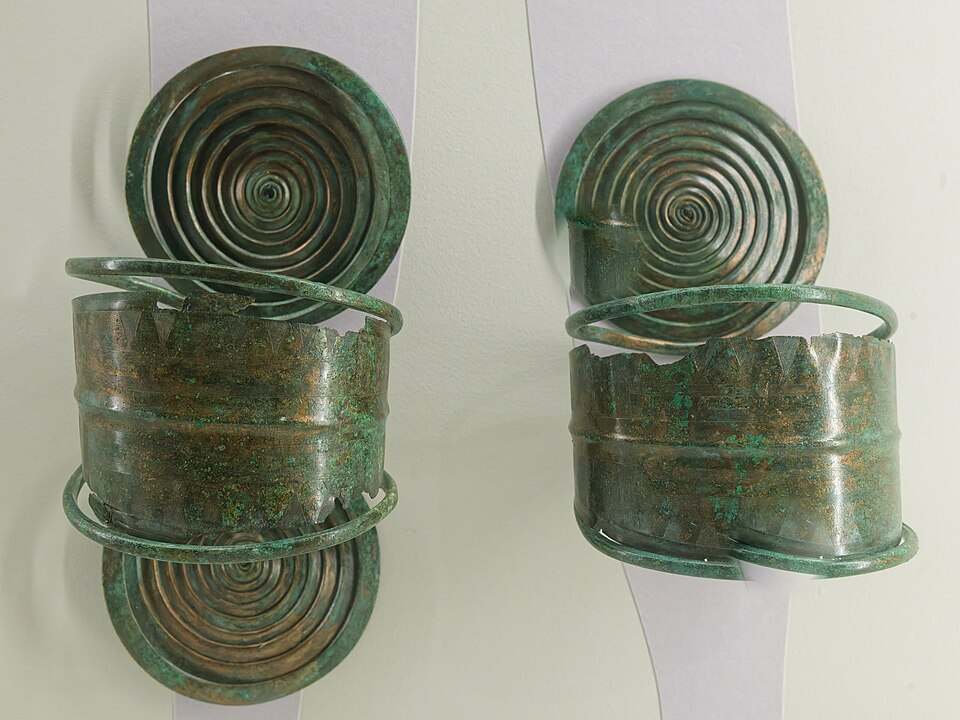
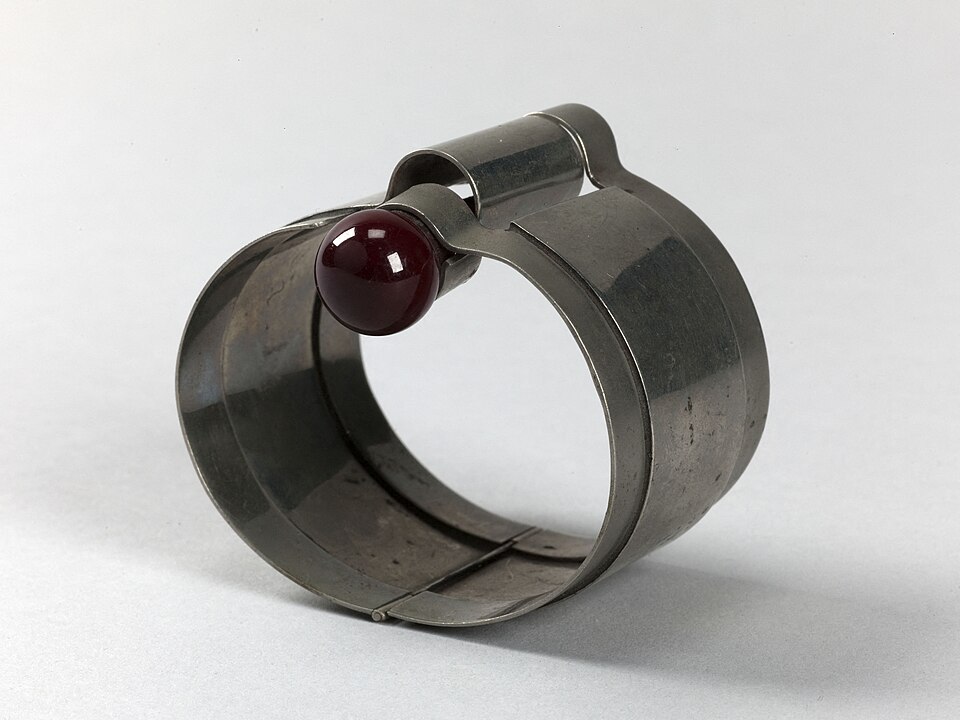
A bangle is a traditionally rigid bracelet which is usually made of metal, wood, glass or plastic. These ornaments are worn mostly by women in India, Southeastern Asia, the Arabian Peninsula, and Africa. It is common to see a bride wearing glass bangles at weddings in India. Bangles may also be worn
Khmer jewellery originated in the Khmer Empire. Khmer jewellery has been produced since the 6th or 7th century. Jayavarman VII, while he was an influential figure who established the different trends in Khmer jewellery, is famously represented without any at all in the seated position. The amount of