This article is adapted from Wikipedia, available under the CC BY-SA 4.0 license. Original: Usekh collar. Changes: formatting and images.
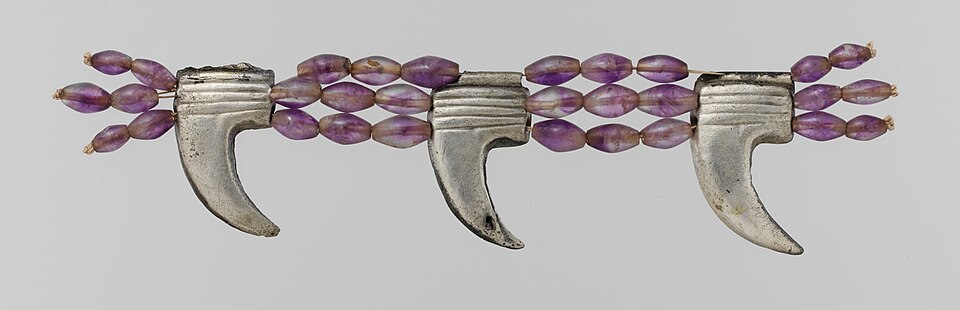
The usekh or wesekh was a type of broad collar necklace used in ancient Egypt. It was composed of tubular and/or teardrop-shaped beads arranged in curved rows, often fitted with terminals and sometimes a counterweight. The usekh is depicted as being worn by deities as well as by both women and men from as early as the Old Kingdom (c. 2670–2195 BC).
Etymology
The ancient Egyptian word wsḫ can mean "breadth" or "width", and the ornament is therefore commonly referred to as a broad collar.
Construction
The usekh collar was worn over the shoulders and around the neck and was fastened at the back. It was typically made from faience, glass, stone, or metal beads, produced in a wide range of colors and strung together with linen thread. Scenes depicting the manufacture of usekh collars appear in a small number of ancient Egyptian tombs.
Over time, the usekh underwent numerous variations in form. These changes may reflect shifting mythological concepts or regional differences within Egypt.
Deities
A scene in the Fourth Dynasty tomb of Wepemnofret at Giza associates the usekh collar with dwarfs and the deity Ptah. Bernd Scheel has argued that Ptah, who is sometimes depicted wearing a broad collar, protected the deceased through the collar, and that dwarfs had access to this protective power through their role in manufacturing such ornaments.
In the Fifth Dynasty tomb chapel of Akhethotep—originally located at the Saqqara burial ground and now housed in the Louvre—one scene distinguishes between two types of collars: the broad collar and the šnw, or "encircling", collar.
Gallery
See also