Hollow Anklet with Designs of Bosses and Chevrons from Thailand, 300 BCE–CE 300
This 300 BCE–CE 300 Bronze object from Thailand is part of The Met’s open-access collection. The article looks at its materials, scale and place in anklet history.
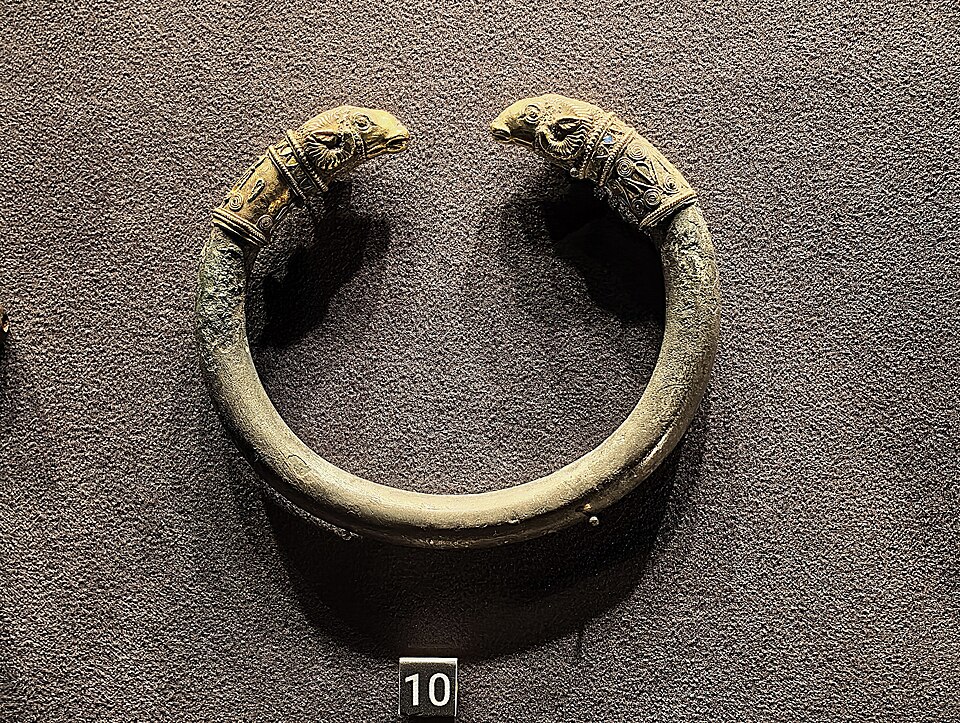
Anklet, Reconstructed Using Claw Pendants and Barrel Beads is a ca. 1850–1775 B.C. Silver over wood core, amethyst object from Egypt, now part of The Metropolitan Museum of Art’s open-access collection. The museum’s record identifies it as jewelry and credits it to Gift of Egypt Exploration Fund, 1904.
Anklets and related body jewelry have a long history across Egypt. Pieces like this were often made to be worn close to the body, where movement, light and the sound of small elements would have been part of the experience. The survival of the object gives a rare look at how makers combined practical fastening with ornament, and how personal adornment traveled across trade routes and generations.
The piece is made of Silver over wood core, amethyst. Working with this material required a maker to balance weight, flexibility and strength: an anklet has to stay in place while the wearer walks, yet remain comfortable against the skin. The museum’s dimensions — L. 14.5 cm (5 11/16 in); w. 3.6 cm (1 7/8 in) — show the scale of the work and help place it alongside other surviving examples of the period.
From a modern styling point of view, the piece is a reminder that anklets can be both delicate and structural. Its Silver over wood core, amethyst surface and ca. 1850–1775 B.C. form pair naturally with simple sandals, bare ankles or a stack of fine chains. The object is also a useful reference for anyone interested in how historical jewelry solved the same problems of fit, closure and comfort that designers still work with today.
Object: The Metropolitan Museum of Art, CC0 (public domain). View the object record. Cover image: Wikimedia Commons, CC0/public domain. This article is original editorial text written for Xiaofei001.
This 300 BCE–CE 300 Bronze object from Thailand is part of The Met’s open-access collection. The article looks at its materials, scale and place in anklet history.
This 300 BCE–CE 400 Bronze object from Thailand is part of The Met’s open-access collection. The article looks at its materials, scale and place in anklet history.
This 300 BCE–CE 400 Bronze object from Thailand is part of The Met’s open-access collection. The article looks at its materials, scale and place in anklet history.